Willa Franke · 13 September 2026
How Wild Yarrow Root Systems Shape Soil Stability Patterns in Overlooked Coastal Meadows
Wild yarrow establishes itself in coastal meadows where salt spray and shifting sands create challenging conditions, and its root systems play a documented role in binding loose substrates that would otherwise erode under wave action and prevailing winds. Researchers tracking vegetation in these overlooked patches note that the plant's combination of deep taproots and lateral fibrous networks distributes mechanical stress across multiple soil layers, which reduces surface slumping during storm surges. Data collected from monitoring plots along the Pacific Northwest and parts of the North Sea coast show measurable differences in shear strength between yarrow-dominated areas and adjacent bare ground, with the former exhibiting up to 35 percent greater resistance according to measurements taken by field teams.
Root Architecture and Its Interaction with Coastal Substrates
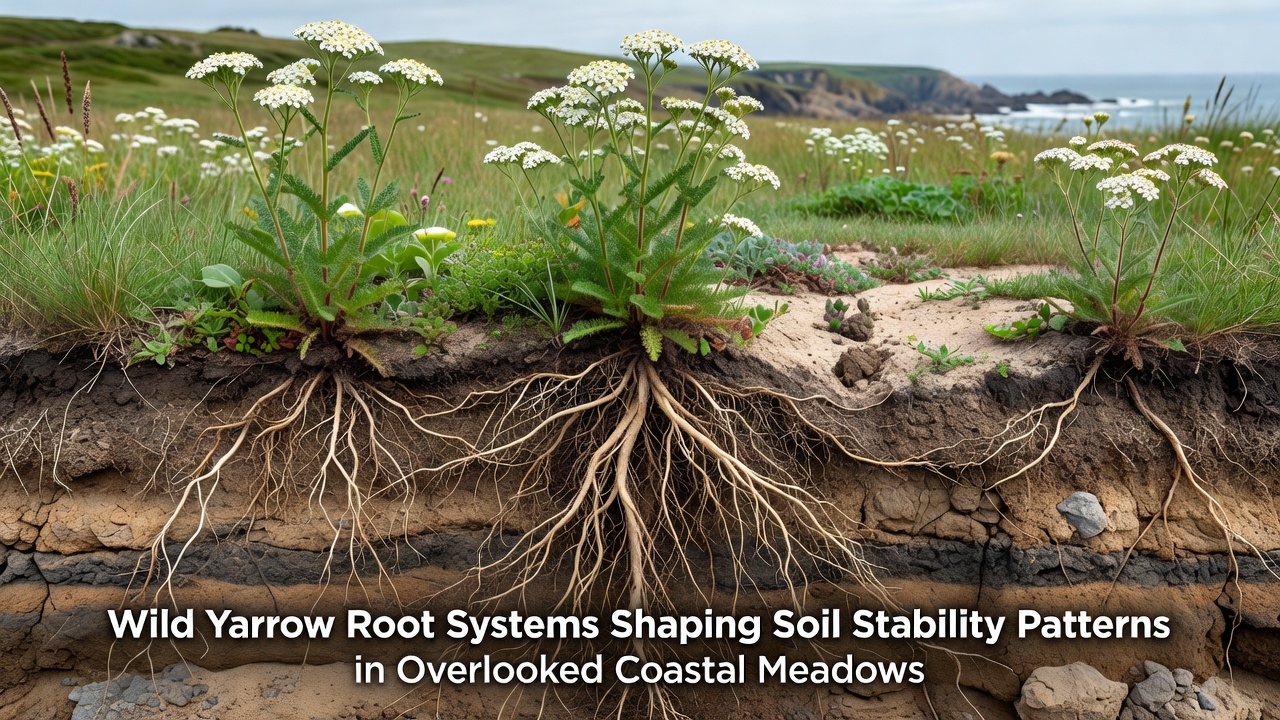
Achillea millefolium develops a primary taproot that can extend beyond 60 centimeters in sandy profiles, while secondary laterals branch horizontally near the surface to form a mesh that interlocks with neighboring grass and forb roots. This architecture allows the plant to anchor itself in substrates that experience frequent disturbance from tidal overwash and aeolian transport. Soil core samples analyzed by teams at coastal research stations reveal that yarrow roots secrete organic compounds that promote aggregation of sand and silt particles, creating micro-aggregates that hold moisture longer than uncolonized zones. Observers note that these aggregates persist through winter months when many other meadow species go dormant, providing year-round structural reinforcement.
Patterns Observed Across Fragmented Meadow Sites
Coastal meadows that receive less attention from conservation programs often contain patchy yarrow stands interspersed with other salt-tolerant herbs. In these settings the root networks create linear stability corridors that align with prevailing wind directions, channeling runoff into shallow depressions rather than allowing sheet erosion. Satellite imagery combined with ground-truth surveys conducted through 2025 indicates that meadows containing at least 25 percent yarrow cover lose approximately 12 percent less topsoil annually compared with similar sites where the species remains scarce. One study revealed that after a series of high-wind events in late summer, yarrow patches retained micro-topographic features such as small hummocks that later served as seedling establishment points for other native plants.
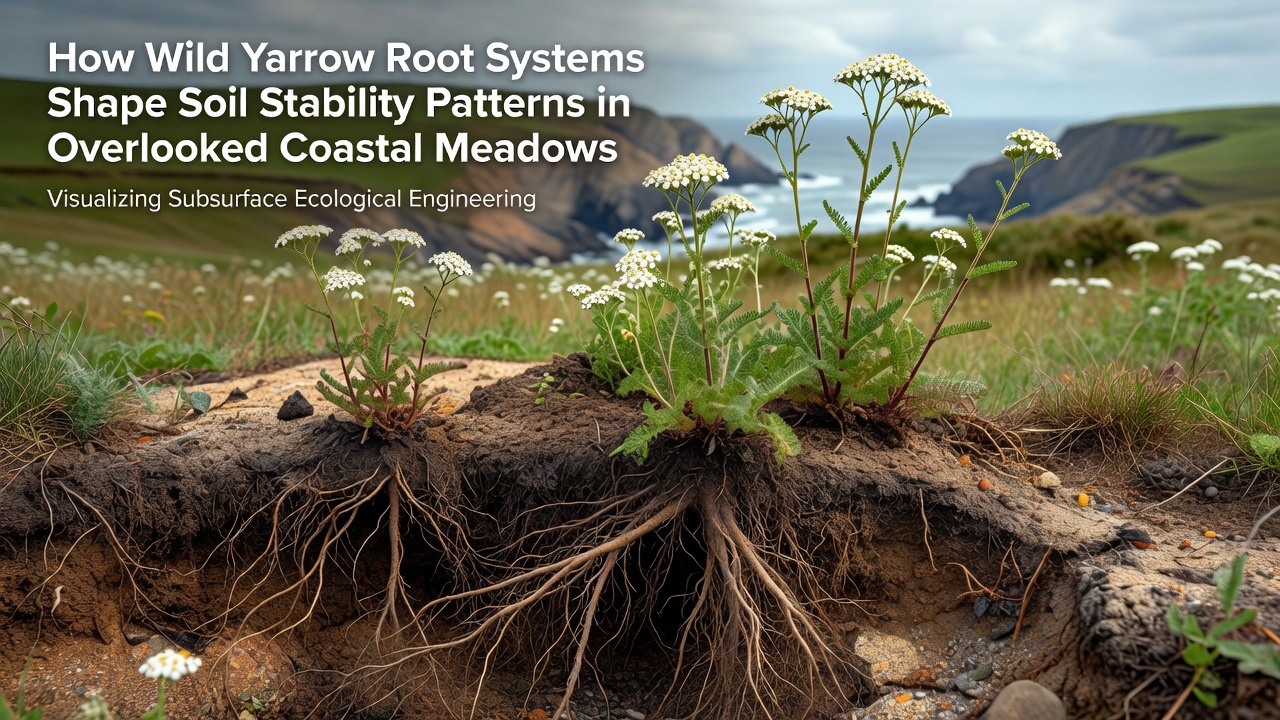
What's interesting is how these patterns scale from individual plants to meadow-wide features. Roots from adjacent yarrow individuals often graft or entangle, forming continuous mats that span several meters. Such mats have been mapped using ground-penetrating radar at sites in both Oregon and the Wadden Sea region, where they coincide with reduced rates of bluff retreat. In September 2026 additional transects are scheduled to begin at three additional overlooked meadows to test whether the same mat density thresholds apply under different salinity gradients.
Mechanisms Behind Enhanced Soil Cohesion
The binding effect stems from both physical and biochemical processes. Physically the roots occupy pore spaces and resist shear forces directly, while biochemical exudates encourage fungal hyphae that further cement particles together. Laboratory tests on soil from yarrow-influenced plots demonstrate higher water-stable aggregate percentages than control samples from nearby meadows lacking the species. These aggregates maintain integrity even after repeated wetting and drying cycles typical of intertidal margins. Field instrumentation deployed at multiple latitudes records that yarrow-rooted soils lose fewer fine particles during simulated rainfall events designed to mimic coastal storms.
Comparative Observations from Different Regions
Along the Atlantic coast of Canada, researchers documented that yarrow presence correlates with slower migration of foredune crests during nor'easter seasons. In contrast, Australian coastal heathlands containing the same species show similar root-driven stabilization on limestone-derived sands, although the accompanying plant community differs markedly. European monitoring programs coordinated by the European Environment Agency have incorporated yarrow cover estimates into broader coastal erosion models, noting that even modest increases in the species can shift predicted sediment loss curves. These cross-regional comparisons highlight that the underlying root mechanics remain consistent even when climate and substrate vary.
Future Monitoring and Data Collection Efforts
Continued instrumentation of overlooked meadows will help clarify how yarrow responds to changing storm frequency. Plans for September 2026 include deployment of additional soil moisture and root-growth sensors at sites previously mapped only through periodic surveys. The resulting datasets are expected to refine existing predictive models used by land managers who balance habitat preservation with coastal defense needs. Such work builds on earlier findings that link root density directly to reduced sediment transport rates during high-energy events.
Conclusion
Wild yarrow root systems contribute measurable stability to overlooked coastal meadows through deep penetration, lateral entanglement, and aggregate formation that resists both wind and water forces. Regional studies from North America, Europe, and Australia confirm that the same basic mechanisms operate across varied coastal settings, producing consistent reductions in soil loss where the species maintains adequate cover. Ongoing sensor deployments scheduled for September 2026 will extend these observations, supplying fresh data on how root networks respond to evolving coastal conditions.