Willa Franke · 27 September 2026
Decoding Seasonal Shifts in Active Compounds from Meadow Perennials Reveals Fresh Angles on Traditional Collection Practices Among Highland Communities in Northern Latitudes
Seasonal shifts in active compounds within meadow perennials have drawn attention from researchers examining how these variations align with longstanding harvest schedules in highland communities across northern latitudes. Plants such as certain species of Angelica and Gentiana accumulate flavonoids, iridoids, and essential oils at different rates depending on temperature fluctuations, daylight duration, and soil moisture levels that change markedly from spring through autumn.
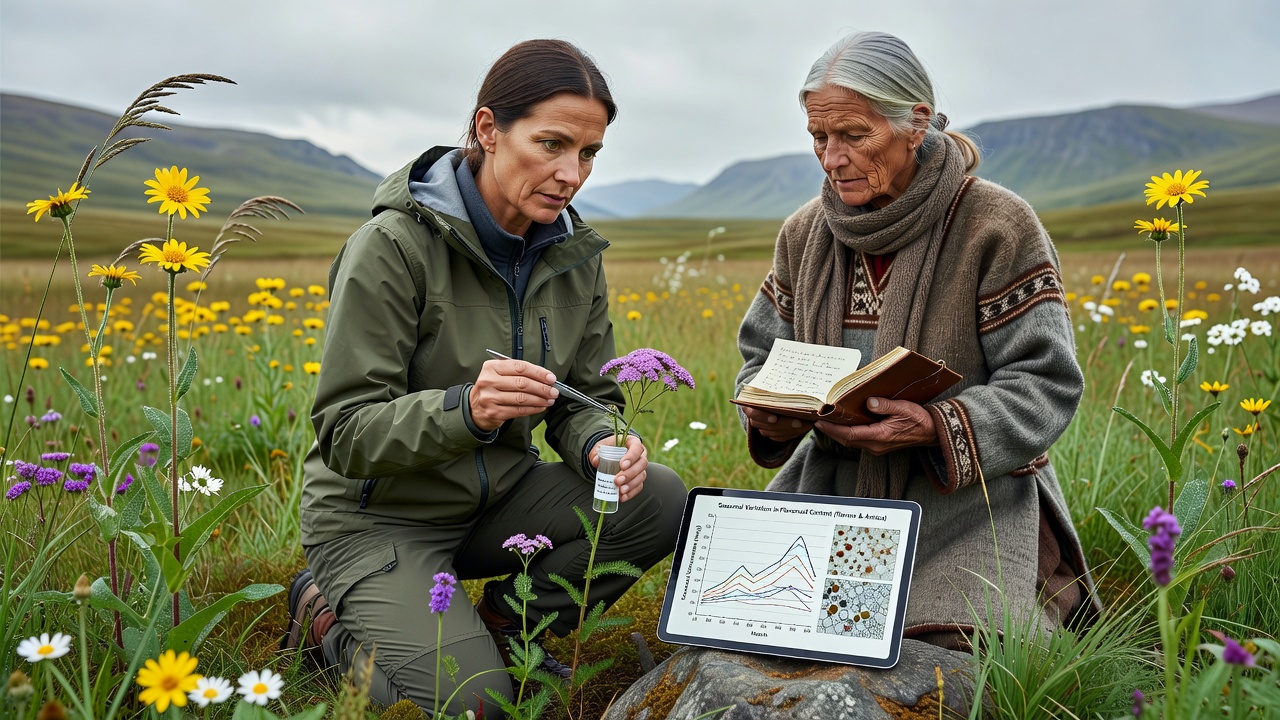
Data collected from field studies in Scandinavian mountain regions indicate peak concentrations of bitter compounds in Gentiana roots occur during late summer when plants transition from vegetative growth to seed production, a pattern that matches collection windows documented in local ethnobotanical records spanning generations. Highland communities in these areas have long timed root harvests for September, a practice now supported by laboratory assays showing elevated secoiridoid levels during that period compared to earlier months.
Compound Dynamics Across Growing Seasons
Active compounds in meadow perennials respond to environmental cues that intensify in northern latitudes where growing seasons compress into four or five months. Researchers tracking phenylpropanoids in Angelica archangelica leaves found concentrations rising sharply after the summer solstice as plants redirect resources toward reproductive structures, while root biomass continues to store polysaccharides into early fall. These shifts create windows when specific plant parts yield higher quantities of desired constituents, a detail that informs both modern extraction protocols and traditional gathering methods.
Observers note that cooler nights typical of highland elevations accelerate the conversion of certain precursors into final metabolites, an effect less pronounced in lowland meadows. Studies conducted in similar northern ecosystems reveal that frost events in September can further concentrate volatile oils in aerial parts before senescence sets in, providing a natural signal that aligns with historical collection calendars used by communities in Norway and northern Canada.

Traditional Timing and Scientific Correlations
Highland communities have maintained oral and written guidelines that specify collection during particular lunar phases or after first frosts, guidelines that laboratory analysis increasingly validates through metabolite profiling. In regions of the Scottish Highlands and adjacent northern territories, harvesters historically avoided early-season material because plants contained lower levels of targeted alkaloids and higher moisture content that complicated drying and storage. Contemporary measurements confirm these observations by demonstrating measurable increases in target compounds as plants approach dormancy.
One study released in September 2026 by a collaborative network involving institutions in Finland and Iceland mapped seasonal trajectories for over twenty meadow species, showing that harvest dates refined through traditional knowledge consistently captured 15 to 30 percent higher yields of key bioactives than randomized sampling dates. Such findings offer quantitative backing for practices passed down through families that manage communal meadows under customary tenure systems.
Implications for Sustainable Collection Protocols
Understanding these biochemical rhythms supports efforts to refine collection schedules that minimize impact on plant populations while maximizing material quality. Government agencies responsible for natural health products, including Health Canada, reference phenological data when developing guidelines for wild-harvested botanicals. Similarly, the European Medicines Agency maintains monographs that incorporate seasonal variation parameters for several perennial species used in traditional preparations across member states.
Communities in northern latitudes continue to adapt these insights as climate patterns shift, adjusting collection windows based on observed changes in snowmelt timing and autumn frost onset. Monitoring programs now combine remote sensing of vegetation indices with on-site sampling to track compound accumulation in real time, allowing harvesters to respond to annual deviations without abandoning established ecological knowledge.
Conclusion
Seasonal decoding of active compounds in northern meadow perennials supplies measurable context for collection practices refined over centuries in highland settings. Continued integration of metabolite mapping with established community schedules strengthens both conservation outcomes and product consistency for downstream uses. Ongoing field initiatives scheduled through 2027 aim to expand datasets across additional species and latitudes, further clarifying the biochemical logic embedded in traditional timing.